20 January 2011

More to Sestriere than beauty and skiing

Sestriere dressed up for the 2006 Olympics
This seems like a good time to start slipping in some of the posts I have been meaning to get to for ages. I think I will layer them up between some of the recipes that I have been trying to get to as well. The weather is nice out, but it's still mid winter so indoor activities are not out of order until we get some fresh snow and the outdoor playtime is back on the map.
Whenever our guests, or us for that matter, are headed up to Sestriere ski area, we always make a point to recommend stopping by at least 2 places, (there are more, of course) when you find yourself in this part of the alps, Carlo's and Constantino's. Two diverse places, but within a stones throw of one another, the main ski slopes and usually, open year round, no matter the season. Wander up Via Louset after turning from SS23 that brings you to the center of town and it won't take you long to discover Carlo's wonderful handiwork spilling out from his "Trucioli d'Autore" shop's front door. You might even encounter a few flying wood chips as well.
Carlo Piffer 
His graceful and clever wood sculptures are also found liberally sprinkled all around Sestriere and throughout the upper Chisone valley, gracing various nooks and crannies with wooden trees and all sorts of memorabilia depictions from the 2006 Winter Olympic games that happened here.
Olympic Flame
He has quite a range of small whimsical ornaments in his shop that are made with a laser cutting process,  making sure that you will find a little something that will fit into your luggage and price range.  You will also find the more substantial and lovingly hand carved pieces that run the range of domesticated farm animals to the various wildlife that live and wander this part of the alps. Carlo also has an interesting and often humorous take on realistic house hold pieces that have a twist to the functionality that turns it into an art form rather than for it's mundane function. 

Table with drape
Festive Trees
High Country Cows
His handicraft is not to be missed when you are in Sestriere and even worth the gorgeous drive up our Chisone valley just to stop in and say Ciao!
You can admire and maybe purchase some of Carlo's lovingly hand carved sculptures and afterwards, satisfy your tummy's rumbling for something to take the edge off your hunger, with a local specialty called Gofri.
Goffrie, Yogurteria, Creperia
Constantino's Gofri joint
 Thin crispy waffles filled with savory fillings like prosciutto crudo and mozzarella or gorgonzola and walnuts or you can head straight for the Nutella filling. You can find a recipe if you feel the urge to make them yourself and some photos of making Gofri here, from a post I did a while back.
Nutella Gofri
Otherwise, I recommend that you head over to the Torre dell'Orologio plaza and grab a seat, if you can, inside or out in this tiny "hole in the wall",  that serves up fresh, fast, and ever so tasty, gofri and crepes as you like them. Savory or sweet, you really can't go wrong with these made while you wait, sandwiches  and pair them with a glass of red or white local wine from an excellent selection of Piedmontese varieties. It's a great choice after hitting the slopes or wandering around the area, to enjoy the beauty of the mountains surrounding you everywhere.
Outside seating year round

10 January 2011

New Year, New Recipe: Chestnut Soup/ Zuppa di Castagna

I must say I think I'm really starting to embrace the Italian ways. Why is that you ask? Because here it is the 10th of January and I'm just now getting back into the swing of my blog on the same day as when the majority of Italians are back to school and work. I'm kind of liking that La Befana (January 6th) and the bridge thing that makes the Christmas holiday stretch out to finish after the weekend following the Thursday Epiphany holiday. Confused? I don't blame you. Suffice to say that the festival of lights, winter solstice, Christmas, New Years, Epiphany and  all of the darkest of  winter holidays are now officially over and I'm joining in the Italians "back to work" today with a new post on my blog. Aren't you glad you asked?
This year I am planning a makeover on BBV to make it easier to find past posts that hopefully I'll be able to split up into various categories for your reading pleasure. Thanks for stopping by. Do feel free to leave a comment or two as I look forward to hearing from you as that is one of the best parts of having a blog, the people that stop by.

Today I'm sharing a recipe for another hearty winter soup, Zuppa di Castagna or Chestnut soup. I will be the first one to admit that it perhaps isn't the most attractive of soups to the eye, but you can dress it up with some sour cream, yogurt, leek and bacon toppings to kick up the eye appeal. I would say it is an intriguing mixture of flavors that when I tasted it at the Martini and Rossi museum's inauguration of the Strada Reale Dei Vini Torinesi, I was immediately intrigued and determined to either find a recipe or recreate the dish myself. I have gone the recreating it myself route, as I find that with much of our cuisine here in Piedmont, many of the recipes are not written down. With a few tries, and some inspiration from some similar recipes around the Internet, I think I have recreated it as best as I remember it. This is a great way to use up any leftover fresh chestnuts you might have kicking around your refrigerator. Chestnuts have pretty much disappeared from the markets, but you can still find fresh cooked ones at the grocery stores. I used some dry ones that were begging to be used from my pantry and so I have given directions for dried chestnuts, but fresh in the shell or vacuum packed will work just dandy. I found a variety of combinations of chestnuts paired with butternut squash or other ingredients on recipes around the Internet that were more colorful or a richer version of this soup. Mine however is more in the tradition of the "la cucina povera" (poor or simple cooking) of the alps. Our woods here are full of chestnuts and potatoes are always our best crop in the garden. This combination is closer to the soup I tasted here. I used dried chestnuts, but I would have readily used fresh or already cooked ones if I had had them on hand and paired them with our garden potatoes as the base. I garnished with whatever might be on hand in a typical alpine pantry, a grate of Toma cheese, but more likely some heavy cream or a dollop of soft fresh cheese or hard grating cheese. Here, you will find fresh Tomini, which is a type of ricotta but stracchino, crecenza or mascarpone would do very nicely. I used my homemade yogurt, which gave it a nice tang and cut through the richness of the chestnuts. Naturally, Greek yogurt, creme fraiche or sour cream would all be most acceptable additions. When it was served as a part of the aperitivo offerings, it was presented in tall clear crystal cubes with a dot of cream.  I included that presentation in my photos as well as I found it a fun and different presentation that  added interest to the buffet.  I have added some typical toppings that make a nice addition to the soup for variation and contrast and is what we like to add to many of our different hearty winter soups. Sauteed leeks, crispy pancetta, bacon or garlicky herby crostini/ croutons or maybe even roasted pumpkin seeds. I think you get the idea. The toppings almost make for a completely different soup. So have at it, and use those lingering chestnuts for a comforting winters day soup.
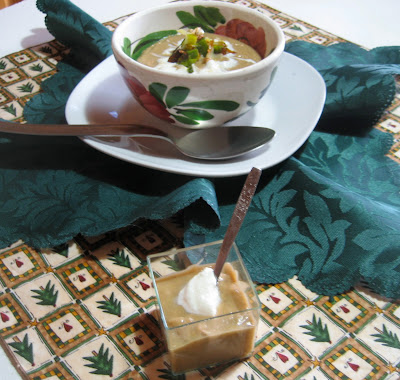
Zuppa di Castagna /Chestnut Soup
Serves 4

200g dried chestnuts (about 8 oz) or fresh* you'll need more to compensate for the hulls
½ lg onion (100g/ 4 oz) sliced in medium pieces
1 lg carrot (80g/ 3oz chopped in to half moons
1-2 celery stalks (80g/ 3oz) chopped
2 bay leaves
2 medium potatoes (275-300g/ 10oz) peeled and cubed
1 Lt of water to cover, approximately

olive oil to saute´ all
Salt and Pepper to taste

Garnishes
yogurt

2-3 large leeks (250g/ 9 oz) sliced into rounds or half rounds


Clean and rinse your chestnuts. 
Cover with hot water and let set for ½ hour or so.
Saute the onion, carrot and celery in a sauce pan or a pressure cooker like I did, till the vegetables become fragrant and start to pick up some color.
Add the soaked and drained chestnuts along with bay leaves to the vegetables.
Cover with water and bring to a boil.
If using a pressure cooker, cook at pressure for about 20 minutes. If cooking in a regular sauce pan cover a simmer till soft. Should take at least an hour. Chestnuts should be very soft. You might need to add water it it evaporates and gets too dry.
Cool the pressure cooker down. I do this quickly by running it under cold running water to lower the pressure faster.
Open and add the potatoes. Season with salt and pepper and cook until all is soft.
While all is cooking, saute´ your sliced leeks in some olive oil until crispy.  Sprinkle a little salt over the leeks. Set aside as a garnish.
Buzz the soup till smooth with a hand immersion wand, food processor or blender, adding additional reserved liquid if needed. I don' t mind if the soup isn't perfectly smooth as I prefer a bit of texture.
If your soup looks to be really soupy, you might consider draining off some of the liquid and reserving to add back in if the soup turns out to be too thick. It's easier to add needed liquid back in than to try and thicken the soup after you have creamed it. It will have a tendency to stick and burn if you try and reduce it after you have blended it.
Adjust seasonings as needed.
Serve in bowls with a swirl of yogurt and a generous sprinkle of crispy leeks or any other favored topping.
Cooks notes
* Check out Ciao Chow Linda's richer Leek and Chestnut version and her method of using
fresh chestnuts here.
Other possible additions or toppings
Greek yogurt, creme fraiche or sour cream
Ricotta, stracchino, crecenza or mascarpone
Crispy pancetta or bacon cubes
Bread cubes sauteed in a pan or browned in the oven with olive oil/butter, garlic, sage, rosemary or oregano, basil, whatever suits you. I tend to use rosemary and sage in the winter.
Toasted salted (or tamaried) pumpkin, sunflower or sesame seeds or a mix of all three.

25 December 2010

Merry Christmas and Buone Feste a Tutti

Click to play this Smilebox greeting
Create your own greeting - Powered by Smilebox
Make a free ecard
We're enjoying a white Christmas and hope you all are enjoying a pleasant time with the ones you love. If you want to see a little of what we are up to at Bella Baita, then play our Smilebox for a taste of Bella Baita. I'll be back to posting real soon.
Wishing you peace and prosperity and maybe even a visit with us at Bella Baita, Italian Alps Mountain Retreat in 2011!

16 December 2010

Candied Orange Peel

I will be the first to say that this may not be a recipe that everyone will be rushing to make, but for those of you who want to try your hand at candying orange peel, this a great recipe. It takes a bit of organization of your time, but it really is worth it, especially if you are like myself and can't always find ready made candied orange peel that you trust isn't full of preservatives and coloring. You still have time to get this made for Christmas, especially if you use the great suggestion of my chef friend Michelle in Portland. She suggested using a dehydrator to get your peel to the storage stage not only quicker, but more assuredly when you live in the land of the moist.  Here in the alps, it is certainly drier than the northwest, but noting like the rockies where everything dries out whether you want it to or not. I just finished a batch each of lemon and orange peel drying them both in my dehydrator. Wonderful results. The orange peel took a bit longer as they are fleshier than the lemon peel and the orange peel takes a double dose of poaching  syrup to insure the peels are completely covered. I also find that the citrus syrup that is left over when you go to dry your peels makes a welcome addition any number of things, like  a fruit salad or your second cup of coffee for the day, just to name a couple. Noting really goes to waste. I make Pannetone and ricotta cake at Christmas time and through the winter, so I have plenty of uses for these lovely jewels. One of my favorite and colorful cheese maker/vendors from the Pinerolo market is regularly petitioning me for my ricotta cake made with his ricotta, of course. You can find that recipe here. I think I'll make some florentine wafers as well which uses candies orange peel as well.  You might find any number of new ways to enjoy them too once you realize what a treat they are and not the oftentimes sticky, gaudy colored fruitcake mix you find in the mixed candied fruit selection during the holiday season.  I dipped some thin slices of the orange into melted chocolate and am now looking to making another batch as those went down just a tad too easily. 


This recipe comes from Inge's "Candied Organic Lemon Peel" recipe over at "Vanielje Kitchen", who seems to be on an indefinite hiatus from blogging, but her blog is chock full of great recipes. I hope some day she returns to her blog as I miss her voice and wonderful stories.  In the mean time have a nosey around her site. I have changed very little from her original recipe, except to double the liquid and sugar when making orange peels to insure the bulky orange peels are covered and added a few of my observations. The dehydrator is a great way to speed up the drying time and make for, I think, a more consistent  final product, due to having some control over the drying process. I've made them with and without a dehydrator, so don't let that stop you from making them if you don't have one, but do utilize it if you do have one, as you can cut the process down to a much quicker process with excellent results.

The recipe below is for the peel of 6 oranges. Try to use organic oranges, which means the peel is both unwaxed and pesticide free. If you can’t get unwaxed or organic oranges, scrub the fruit with a clean bristle brush in warm soapy water. Rinse well and dry.
Candied Orange and Lemon peel

Candied Orange Peel 
(**Candied Lemon  Peel also **)
DAY 1:
  • Cut your oranges in half and juice them, reserving the peel or remove the peel in quarters and reserve the flesh to juice later. I tend to remove the peel in quarters.
  • Scrape away much of the pith with a small knife edge, leaving enough to giv the peel some body. I scraped all of the pith away once and found it was thin and dried out too much, making it brittle and not the nice chewy pieces we're looking for
  • Place the peel in a saucepan, cover with water and simmer for 30 minutes
  • Drain the peels, return to the pan and cover with fresh water
  • Simmer for a further 45 – 60 minutes
  • Drain, reserving about 3 cups (750g) of the orange water, and set the peels aside
    ** If making lemon peels use 1 1/2 cups (375ml) of the lemon water **
  • Add 2 cups (500g) of granulated sugar to the pan, with the reserved water
    **1 heaped cup (250ml) granulated sugar for lemon peels**
  • Stir on a low heat until the sugar has dissolved and then bring it to the boil.
  • Once the sugar syrup reaches boiling point add the peel and turn down the heat, simmering for a minute or so.
  • Remove from the heat and allow to cool.
  • Once cool decant into a sterilized bowl, cover and leave in a cool place for 2 days.
DAY 2:
  • After 2 days remove the peel and decant the syrup into a pan.
  • Add 3/4 cup (188g) of sugar, heating slowly to dissolve.
  • Add the peel, bringing to a boil, then simmer until the peel is translucent.*
  • Cool, then store in a covered bowl for 2 weeks.
If using a dehydrator you can skip to the drying stage now *
DAY 15:
  • Drain the peel, discarding the syrup
  • Lay the peel on a rack, not touching and cover with a sheet of wax paper. This will keep the dust off while the peel dries. Air should be able to circulate.
  • Put in a warm dry place to dry for two days, turning the peels occasionally to ensure they dry evenly.
Sprinkle with caster sugar and store in an airtight container. Best kept in a cool place, dark place of possible.

*Dehydrator method
  • After boiling the sugar water and peel till translucent, cool until able to handle, but while still runny, remove peel.
  • Place peel on a wire rack, like one used to cool cookies that has been placed over a clean cookie sheet and allow the excess syrup to drip off. If you don't have a wire rack you can just place then on a cookie sheet or parchment paper to drain. Once fully drained, arrange the slices on your dehydrator racks and dry till dry to the touch, but still pliable. 
Cooks notes
It is really important to cook the peel to the translucent stage. It will look physically different. It takes a while to get to that stage, but don't stop too soon, or the peel won't keep it's chewy quality or you run the risk of the slices molding later on.
It took me a few hours, but not overnight to get the slices dried to where I wanted them. The next day I had a couple of the slices that seemed to still be quite wet, so I dried them separately a little longer. I also found that I didn't need to dip them in the caster sugar. If I find later on that they are too moist, I may then press them into the sugar, but at this point I don't think I will need to.

03 December 2010

Golosaria at Torino

Golosa. Yes, that is what I would say most of us attending the Golosaria in Torino this past Monday could be characterized as. What does goloso mean? It's a polite and quaint way of calling you greedy.
Golosaria is a gathering of tasty food and drink offered up for the sampling of the greedy. 
We did our part of coming along to sample what was on offer and enjoy it all being served up in Torino's ever so elegant Teatro Regio.  Each year there is a different venue keeping it always interesting to discover new places. Walking into the plush red lobby of the theater, definitely got me to thinking about how wonderful it would be to attend an opera there. This years season seems to be all Verdi all season. Not a bad choice in the lot. 
Ah yes, back to the sampling and schmoozing. 
There were a smaller gathering than usual this year and could be a sign of the economic times, but there was a good turn out of samplers and that hopefully was good for sales for the exhibitors.
The unmistakeable aroma of truffle greeted us and it didn't take long to follow the scent to this booth.
White truffle from Alba for your gastronomic pleasure, fresh to enjoy now, grated over risotto and whatever else strikes your fancy or truffle oil to drizzle later.
There were numerous offerings of wine, digestivi, chocolate, cookies, confiture and marmalades of every persuasion. Colorful potatoes from the mountains on the other side of our valley and Toma from Lanzo valley were particularly enticing.
  
Finishing off the day with a stroll back to the train station, the store windows beckon to continue on the culinary feast. Torino really is a feast for the senses, with its architecture and old world elegance. It takes its food and cafe culture very seriously, like most Italian cities, so there is no shortage of opportunity to indulge in a bit of low fat window shopping.

So until our next visit to the big city I hope you enjoy this peek into Torino. 
Bookmark and Share