Showing posts with label Piemonte. Show all posts

05 June 2017

Making Fresh Tomini Cheese at Home

fresh Tomini Cheese
Super fresh Tomini Cheese
Tomini Cheese, in this part of Piemonte, Italy, means a soft fresh cheese that looks a lot like miniature ricotta cheese. Looking up Tomini in the large Piedmont chapter of our Slow Food book on Italian cheeses, Tomini is referred to as Tomini di Talucco, which happens to be the valley just on the other side of our on hillside, and it refers to it as pure goats cheese. It also states that the territory of origin comes from not only Talucco, but Grandubbione, which is where our road deadends  5 km further up the road from our house. It is the only Tomino listed in book which covers ever single region of Italy. So this type of cheese really is from our neighborhood. 
Here the Tomino is eaten in it's fresh state after a day of settling and letting the water drain out, it is salted top and bottom. Tradition is also to mature the cheese after it has firmed up by dusting them with some black or red pepper, or domestic or wild thyme and then place it in a earthenware vessel called an "ule", or glass jars, till it is ripened to the cheese makers taste. My mother in law loves to ripen them till they are quite aromatic.
Earthenware "ule" for ripening tomini cheeses, missing its lid
Ripened Tomini using black pepper and hot red pepper

So in our part of northern Italy Tomini was made completely with whole goat milk, although with changing times and palates you will find it also made with half goat and half cows milk or an all cows milk variety for those that like the style of cheese but not so fond of goat milk. I love goat cheese, so I'm a fan of the original, but not opposed to the other varieties. They are all delicious.
There is also a variety of Tomini that is sometimes called dry Tomini that has been innoculate to form a white crust similar to brie cheese. Most cheese makers here call this type of cheese Pagliarine. It's a great cheese, but to me it tastes nothing like the Tomini type that is typical to here. 
Dry Tomini or what most cheese makers here call Pagliarine
I've seen a variety of cheese makers work their their magic and thought why not give it a go at home since it seems relatively easy and I have access to fresh unpasteurized milk from what I like to call our mechanical cow over in Pinerolo.   It's great because it still has the cream on top once it sits and it truly is delicious. It's our very own local milk without the milking. 
Fresh unpasteurized milk, €1 per liter
We have a lot of cheesemakers in our valleys and a long history of being famous for our cheeses. Its been said that General Hannibal, of the elephant fame, crossed the Alps around 3through our valleys because it was not only the quickest way to cross, but it was an opportunity to try and nourish his dwindling number of men on our Alpine dairy products, most notably cheese. 

A few years back we went to a Tomini cheese making demonstration in Talucco at Agriturismo Pinareul Arios, which just happens to be cousins in the extended way that people are related when your family has lived in the neighborhood for many generations. They still make their Tomini over a wood fired stove and it all done by hand within the family. They also operate a charming dining room that features their delicious genuine home grown and made food and is famous, not only for their Tomini, but for also their Fritto Misto alla Piemontese , an extravaganza of all sorts of savory and sweet fried foods. It's a popular indulgence in these parts and they do it well.
Hand produced Tomini di Talucco at Pinareul Arios
We also take guests up our Chisone valley to Vento Grigio Farm for a demonstration of milking and Tomino making complete with a light picnic lunch outdoors with a fabulous view of the Chisone valley and a change to have a go at milking a goat if you want to. Naturally we get to sample some of Cesare's pure goat cheese Tomino and you won't be disappointed. 

Milking Goats at Vento Grigio
So now you can try and make some at home, as it isn't difficult, you just need some good quality whole milk, cows or goat, a large stainless steel cooking pot (needs to hold at least 5 quarts liquid), some rennet for producing the curds, something to hold the curds  and shape the cheese while allowing the water or whey to drain out. 
There are proper forms that you can find from cheese making suppliers or some cheese cloth lining a strainer or colander that you could use  while you decide if this is something you might make more than once in a blue moon. 
Tomino making steps

Tomino Cheese 

12 approximately cheeses, depending on how well you fill them

Equipment:

1 - 5 liter cook pot, stainless steel best
Cooking thermometer
5 cm x 4-5 cm (2inch x 1.75 inch) round cheese form for draining cheese in (strainer lined with cheese cloth will work) 

Ingredients:

4 liters ( 4 quarts) whole milk, best if unpasteurized, but can make it with pasteurized milk
2 grams per liter (8 g = 1.6 tsp ) caglio ( rennet or vegetable rennet) 

Method:

If the milk has been refrigerated, let the milk set out to bring it to room temperature before heating. 
Place ambient temperature milk (37*C /  98.6*F)  in the large pot. 
Slowly raise the temperature of the milk to at least 75*C (167*F) that will pasteurize the milk. 
The milk can go as high as 85*C (185*F) 

According to some cheese makers, bringing the milk to 75*C-85*C (167*F-186*F)  pasteurizes the milk but leaves some good bacteria that adds flavor and nutrition. 

If you heat the milk all the way to 90*C (194*F) it sterilizes the milk. 
Once the milk reaches the desired temperature hold the milk there for at least 5 minutes.  

My pots hold the heat quite well, so I turned the heat off and kept the thermometer in the milk to make sure the heat didn't dip below the 75* mark until after the 5 minutes. Descriptions of making Tomini states the milk needs to go to 85*C, but cheese makers seem to have varying opinions on this point. It seems to be their twist on making the Tomino recipe their own.

Allow the milk to cool down in the cooking pot to 38* (194*F). 
While the milk is cooling measure out your caglio (rennet) and have it ready to add immediately at 38*C (195*F) 
The temperature can drop quickly so keep a close eye on the temperature of the milk.

Add the caglio (rennet) and stir throughly to distribute the rennet. Cover the pot with a lid and allow to cool undisturbed for at least 40 minutes - 2 hours.  You can raise the lid to peak in just don't stir or move the pot gently if needed so as not to disturb the milk curds. I did the 40 minutes one time and it didn't seem to be enough time for mine to set properly, so now I just go with the 2 hour timing. 
Once you let it cool down you will find that the milk has softly solidified and pulled away from the sides of the pan. There will be a clearish whey formed between the cheese and the pot. 

Take a long handled spoon or metal spatula and start by making a long cut through the top to the bottom of the curd and draw a line horizontally toward you. Lift the spatula out make the same motion horizontally across the curd to form the blessing of the cross. 
Then gently cut the curds up the same way throughout the whole of the pan until the curds form and the whey begins to be throughout the whole pot. Let the curd set for a few minties and then either scoop up the curds with your form or fill the forms gently lifting the curds and pouring then into the draining forms. Fill a few forms and keep going back to refill, as the curds will give a lot of whey even after sitting. 
**Do not let the cheeses sit in the drained whey because it is bitter from the rennet and will give an off flavor to the cheese. There are draining trays here for helping with that problem, but even with those you must keep watching them for a few hours as they will give off whey for a couple of days. After the first few hours the amount will slow down, but be very vigilant with making sure the cheese does not rest for very long in the whey. 

They can be eaten after a couple of hours, but will be quite soft. I would let the others sit at least over night if you can before unmolding them to stand on their own. If desired, you can sprinkle a bit of salt on the top and bottom of the individual cheeses, but not everyone does that. Many people here prefer them with out the salt to taste the freshness os the milk. its a bit like unsalted and salted butter. They both have their place. You can always salt them to taste when eating. 
The cheeses will last several days to a week ot so depending on your salting or not and how you hold them. I keep the nin the refrigerator unless I am going to salt them and dry them with a bit of pepper or herbs. After a day or two of air drying you can then put them in the jars or earthenware jar. They will get strong tasting after a week or so and you can ripen them to taste. Usually for us, they never get that far, as we will have eaten them with tomatoes, and a drizzle of good olive oil or hot pepper oil, a few cranks of fresh cracked pepper for a delicate fresh cheese that you made yourself. 
Do enjoy.
Fresh Tomini cheese with a parsley garnish
*The whey is good as an addition to bread and some types of baked goods. It has also been used in making home made soap. You will find that many animals will enjoy the rennet also, but not all. 

26 January 2017

3rd Annual "SMTA - Sustainable Mountain Tourism" Ostana, Italy

Heading over towards Monviso, in the distance, to Ostana
It's the beginning of another annual ride around the sun for all of us who mark our calendars beginning with January 1. 
What will 2017 bring to us and what will we focus on in our alpine Italian life?  
Good questions that had one immediate answer when Fabrizio was searching around the internet one night last week. Lo and behold he found a symposium on "Sustainable Mountain Tourism" that was to take place in 2 days time in Ostana, Italy, which just happens to be 65 km away and a couple of mountains over from us, where mighty Monviso peak resides.                                                               
Approaching Monviso -Ostana in the Summer
Naturally this piqued our interest as we started our own "Sustainable Mountain Eco Tourism" - "T.E.M. Association" ( Tourismo Ecosostinible Montano- Associazione Di Promozione Sociale) about 10 years ago. 

What is sustainable mountain tourism you might ask?
 A simple definition of sustainable tourism that lines up with our beliefs I found on the   The Sustainable Tourism Gateway website. 
"Sustainable tourism in its purest sense, is an industry which attempts to make a low impact on the environment and local culture, while helping to generate income, employment, and the conservation of local ecosystems. It is responsible tourism that is both ecologically and culturally sensitive."

Our Eco Sustainable Mountain Tourism Association Logo

The addition of Mountain into Sustainable Tourism, creates a specific viewpoint as life in the mountains can be a delicate balance between maximizing economic development and protecting fragile environments and sensitivity to cultural heritage.
According to "Euromontana", a European association of Mountain areas, with whom we presented our Bella Baita B&B  mountain living model to their annual meeting in 2013; 60% of all Europeans live in the mountains. I found that statistic to be rather astounding and important to consider how important it is to support these rural and sometimes fragile communities. 

Anyway.....


We were thrilled to write to the SMTA and within minutes find out that they were happy, on short notice, for us to attend their 3rd annual international  edition of "SMTA  Sustainable Mountain Tourism Alliance"
It was with great excitement that we set off to join the discussion. We really knew nothing about them, but off we went on Friday (the 13th no less)  to check out this day of exploring what Sustainable Mountain Tourism means, building a meta-network (a network of networks) and the circular economy. 

Arriving at Ostana in winter was just as as impressive as arriving in summer. We drove over there in July for a days outing on my birthday to see a restored and revitalized mountain village that we had heard a lot about. The mayor of this village has been committed to revitalizing for the village for the past 20 years or so to try and breathe new life into what was an almost deserted village.  The buildings were neglected and crumbling after the town was all but abandoned when people moved on to look for economic opportunities, mostly after WWII. We have the same scenario in our mountain neighborhood.  And it was the same story in the mountains of Colorado that I use to live in until they started the ski areas. 

Ostana has struggled along, mostly being home to a few hearty souls and a few who came for the beauty of the area and the outdoor mountain activities that are on hand. The Monviso ski area use to draw in people in the winter when the ski industry was buzzing in the 70's. That however has slowed to a trickle as many ski areas have felt the sharp pinch of the Italian economic slow down along with aging equipment and a lack of funds to upgrade. 
The town's mayor has made a real effort to bring in support for getting the buildings renovated and attracting new life into this small but now growing community. 
Sant Antonia - a small borgata, a part of and up from, Ostana, where our meeting was held. 

We had lunch this summer and also during the symposium at the beautiful Galaberna rifugio, another project that has brought business into the  mountains. There is also a bar and a couple of stores, one offering quaint home accessories and another with outdoor sporting goods and local artisanal products which adds quite a lift to this charming hamlet. The revitalization of this community is a testament to commitment to a vision to bring growth and find the ways and means to do so. Good for Ostana and its residents, you are inspiring. 

Back to the symposium. 
Our symposium was up, and I do mean up, the hill to another cluster of houses and buildings  that had a very state of the art meeting room,  along with a tiny bar that made for a cozy day of exchanging ideas and lively discussions on mountain tourism. 

We met some fascinating people that share many of our ideals of supporting life in the mountains through tourism that supports tradition and innovation. The symposium was led by one of the founding members of SMTA, Swiss educator, Dr. Tobias Luthe, who presented what work they have done in working towards making sustainable tourism a concrete and  viable means of income in the mountains of Europe.  Starting with the focus on concrete means of bringing money for rebuilding and attracting others to live in rural areas that are in need of new ideas for saving abandoned hamlets and revitalizing these communities through reconstruction and touristic activities that can support small local businesses. Tobias was the main moderator but there was at least one other founding member and other students and educators and various business partners who participated and shared their vision for mountain redevelopment. 

We broke out into several small groups to discuss specific topics and came back together to share our thoughts.  One of the things that struck me was even thought we all had the exact same discussion topics, we came up with such diverse ideas and angles of approach. I think that is what makes getting people from different countries and diverse touristic backgrounds together such a worthwhile endeavor. It brings many different points of views and ideas to the table. I found the topics stimulating and the company pleasantly interesting. 
SMTA 3rd Annual Symposium Ostana, Italy
 Dr. Tobias Luthe presenting in the top middle photo
We took a break for lunch with a walk down to Galberna Rifugio for a convivial and traditional Piemontese mountain lunch that was outstanding. High quality food and wine, prepared simply with the personality of the chef shining through, made for a delightful meal together with new friends. Then after our break we trudged back up the hill which seemed to get just a tad longer and steeper on the way back, but the fresh air and beautiful mountain scenery made it all worth the effort. It also helped to keep us alert after such a satisfying meal and enabled us to remain engaged for the afternoon topics. 

Photos of Ostana this past July when we had lunch at La Galaberna.
The food was excellent both times we ate their. Highly recommend it!
The small group discussions included not only what exactly is needed to identify what exactly sustainable tourism is, but how to you brand it so that people will know what they are looking for and what exactly they will be receiving.  Also, how do you measure if this type of approach to mountain tourism is easily recognizable and effective. How do we bring this movement forward together and also concretely measure progress being made. 
Sharing our ideas 
I'm not sure how the symposium found its way to Ostana, but I am sure there is an interesting story there. We learned there is the beginnings of a "Monviso Institute" in progress to bring yet another portion of this cluster of mountain neighborhoods back to life. 
Some of these same folks have bought a small cluster of abandoned houses even further up from these buildings and have started to renovate them to turn them into a project 
"as an experimental real-world laboratory for sustainable design and living." MonViso Institue  
It all sounds very exciting to not only meet people that are trying to generate a way of bringing economic life back to the mountains, but who are actually putting in to practice the systems they are trying to create and nurture. 
In summing up the whole concept of sustainable tourism we talked about a circular economy. The term has been used in the industrial realm to move away from the linear model of 'take, make, dispose' economic model to  "a circular economy that is restorative and regenerative by design, aims to keep products, components, and materials at their highest utility and value at all times. "  
For me a circular economy is really just a getting back to basics of relying on your community to provide services and goods from local sources and sourcing things closer to you so that the money stays in the community and recycles itself around. I love purchasing our food from the farmers that produce it and try to make a habit of keeping that in mind whenever possible. From my perspective we are looking to go back to a system that we lost sight of when the promise of globalization seemed to be an answer to so many needs. Communities use to rely more on each other. I think you still find this interdependence in rural communities still, but it is ever increasingly important to commit to buy and work with local professionals for supporting a healthier and more robust local economy in order to keep the circle to include your neighborhood.  
I think that one of the biggest takeaways from the conference was to generate enthusiasm for thinking globally and acting locally, through talking together and sharing ideas to take back home and see what can be implemented and what other ideas can be generated with ones own community. Our concerns for our natural environment, our neighbors, and communities economic health is brought into clearer focus with an eye towards generating more opportunities to work together with ur neighbors to build the community we dream of. Lofty goals indeed, but starting from where one is situated and reaching out to others is a place to start and communicating around a table, usually laid with  great food, is where we like to start. So we shall see what we can bring about in our community and we look forward to participating with this group again as well as discovering what the MonViso Institute will have on offer as well. 
View of Monviso from our neighborhood
Onward and upward, I say. 
Ciao for now!!

03 November 2016

Slow Food's Biennial Salone del Gusto and Terra Madre Arrives Again


I went, I saw, I explored,  I discovered. I sampled, I chatted, I learned. I imbibed, I flagged, I stayed till the end of the night, arriving home around 2 am-ish and was, well,  exhausted, again.
That, my friends, is the nutshell version of my time visiting this years 2016 edition of Salone del Gusto / Terra Madre. Living the slow life, it seems that getting this post up has all the hallmarks of a sloooooooow post. 

There is so much more to tell and share. I was so excited to share my impressions immediately after the event, as it always leaves me in high spirits, inspired and hopeful that real change is coming to the way we eat, produce our food, treat our animals, planet and each other. However I didn't get to do that right away as we have been busy with guests, gardens and "work-away-ers", so I have had some time to digest and reflect on my experience this year and I'm still pretty excited. So was every one else too.
Bernard Elixirs with Fabrizio, Nina and Enrico Bernanrd

First off, you either are familiar with Slow Food or you are wondering what the heck is this all about?! Their Slow Food International website is a great place to start to learn about what the movement is all about. I have attended quite a few editions of the every 2 year event called Salone del Gusto and Terra Madre and have written about it every time I have gone.

Terra Madre Welcomed Representatives from over 140 countries to this years event
 I went into quite bit of detail from the 2014 edition and you can read more about my insights here, here, and here, and if that isn't enough links will come up below those posts to older editions to this event. I have been attending since 2004.  So now let me talk about this years event. 
This year saw the event taken to a whole other level. They blew the doors off of this event, moving out of the Lingotto Conference center and adjacent venues and expanded into the whole of central Torino for the first time ever. It was a risky move. The weather can be a cruel partner, but moving the event to an earlier time in September instead of October, the chances of the weather holding up were better. We were lucky this year as the weather was cooperative.  Being an almost exclusively outdoor event scattered around the town, there was no longer a need to charge to attend the event,
Piazza Reale Turin
The City of Turin Welcomed 2016 Edition of Salone del Gusto / Terra Madre
Fun for everyone

The Lingotto center had just gotten too expensive to justify holding the event hostage there, according to Carlo Petrini, Slow Food International's President and founder. Carlo Petrini really is the father of this movement and person to whom most look to as the driving force of this grass roots movement. He has written many books and works tirelessly to bring about a change to peoples awareness to preserve our culture and heritage of our basic need to survive, and of course that is our need to eat.
Carlo Petrini, leading the way
To eat. To eat together, to eat with pleasure, with awareness and mindfulness of all that goes into the production of our daily ritual and all of the ripple affects. To be aware that others do not have enough to eat  and to consider the consequences of our food choices that affects not only our health, but our planets health and so very much more. This is a celebration and hopefully a raising of awareness of all these issues and more. It's a mammoth undertaking, but in the words of philosopher Lao Tzu "the journey of a thousand miles begins with one step", and so we take a step on the journey. 

Terra Madre Parade and Welcome that included trading of native foods with one another

The opening ceremony for this edition of Terra Madre featured a parade of representatives from over 140 countries attending this year. It was colorful and joyous. People were also carrying sign boards, with slogans, such as, Love your Mother, Save Biodiversity, Vote with your Fork and other statements. There was a ceremonial exchange of of traditional foods between diverse countries on stage and an general exchange  in the piazza with much merriment. It was an emotional and inspiring symbolic fellowship. It was a festive start to the festivities.
Terra Madre Opening Parade 
I love seeing what people from near and far are producing and eating from all around the world. Parco Valentino hosted most of the many Italian producers as well as the rest of the world.

Parco Valentino Vendors
There was so much to sample and discover and so little time. I arrived early and stayed very late, but truly I really didn't feel like I had been able to take it all in. I did have some nice chats with various Terra Madre people, but didn't have time to attend the many fascinating forums about such diverse food issues, in just one day, but so it goes. I did really savor every delectable experience that I could absorb in the day. I love too that there are always some crafts that go hand in hand with the food traditions and on display representing other aspects of our food cultures and ways of living as producers of our worlds foods. 

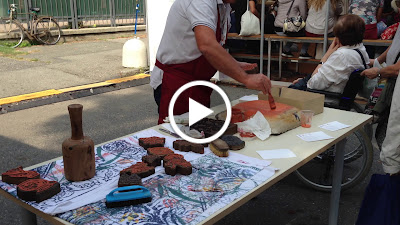
Traditional block stamping for material and paper making lovely crafts
I think I will try and finish off this never ending homage to one of my most favorite events in the world, with a variety of photos, so you can experience a tiny slice of what was on offer. I hope you enjoy the tour.

Beans and Corn of Every Type - Saving Biodiversity

Food, Costumes and Fun
A Few of the Wonderful Things on Offer to Sample and Buy if You Like
People From Around the World, Sharing Their Food and Other Traditions


Perhaps one day you might consider experiencing it on your own. 

Piazza Reale at Night during the Salone del Gusto
Next time around will be in 2018.
See you there.

25 January 2016

New Post for a New Year - Nearby Manta Castle

Manta Castle
Here it is past the middle of January and time's awasting.  I must make haste to keep up with some very modest goals I have set forth for myself and my blog for this year. I noticed that when I was writing a roundup of things to do in this area on my last post, that there were many interesting attractions noticeably missing from my lists.  I have been meaning to get around to writing about a few of them for a long tim. Others I thought I already had written up, but couldn't locate them perusing through my back posts, so I thought I would make it a goal to post a least once a month about some of the local attractions that we send our guests off to see and usually have taken in ourselves at least once if not a few times.
One such glaring omission is splendid Manta Castle (Castello di Manta), just past and overlooking the charming town of Saluzzo that sits where the base of the Cottian Alps (Alpi Cozie) and Po river plains unite, in the neighboring province of Cuneo.
Monviso of the Cottian Alps meets the Po river plains
Manta boasts a small castle perched on its hillside that has been returned to its former glory when the Lords of Saluzzo called it their home. The original building dates back to the 12th century and over the years the building grew with expansions and richly decorate with various additions of masterful and fantastical frescos whose handiwork still remains anonymous.  The current family descendants  enlisted the help of Italy's preservation society, FAI to help raise funds to restore the deteriorated  paintings, replace furnishings that had disappeared over the centuries and breath life back into the castle. These frescos are said to be a rare treasure of late gothic paintings still found in northern Italy. They really are worth a visit as they are so well preserved and magnificently interesting.
Héros, Heroines, and the Fountain of Youth Frescos
In addition to the main castle they have also restore an adjacent church and plans to continue to restore other surrounding buildings in the neighborhood. They really have done a fine job. I especially like that included with the very modest entrance fee of around €7.50 adults and €3.00 for children (2016 prices) is the use of complimentary headphones to insure you get the most out of your self guided visit. There are a number of different languages offered and they do periodically update the narration to reflect the ongoing historical discoveries or completion of nearby ongoing projects. 
Manta Castles' Church
 The castle is of a manageable size so that it makes for a great half day visit and suitable for children, who will enjoy the artifacts and furnishings as it is not only the paintings and church that are of interest. Nearby Saluzzo is another great place to stop also for a bit of shopping, sight seeing or eating, naturally. The grounds are peaceful and would make for a lovely picnic setting. You can also walk up through the woods or park closer and take a more direct route.
Castle life
Whatever you do, when you find yourself in northern Italy, you will want to make sure and not miss out on this local treasure, when you visit our slice of Piedmont, preferably when you come and stay with us.  We'll be waiting for you with many more suggestions.


The castle is open Tuesdays - Sunday, closed Mondays (unless it is a holiday in which they say they are open. Always good to check)
10:00 - 18:00 March 1 through the end of September and
10:00 - 17:00 October through 27 of November.
Last entrance 1/2 before closing
Closed December through February.

Directions to Castello di Manta from Bella Baita B&B and Italian Alps Retreat

01 April 2015

Winter Gifts from the Garden: Savoy Cabbage and Cheesy Potato Bake Recipe

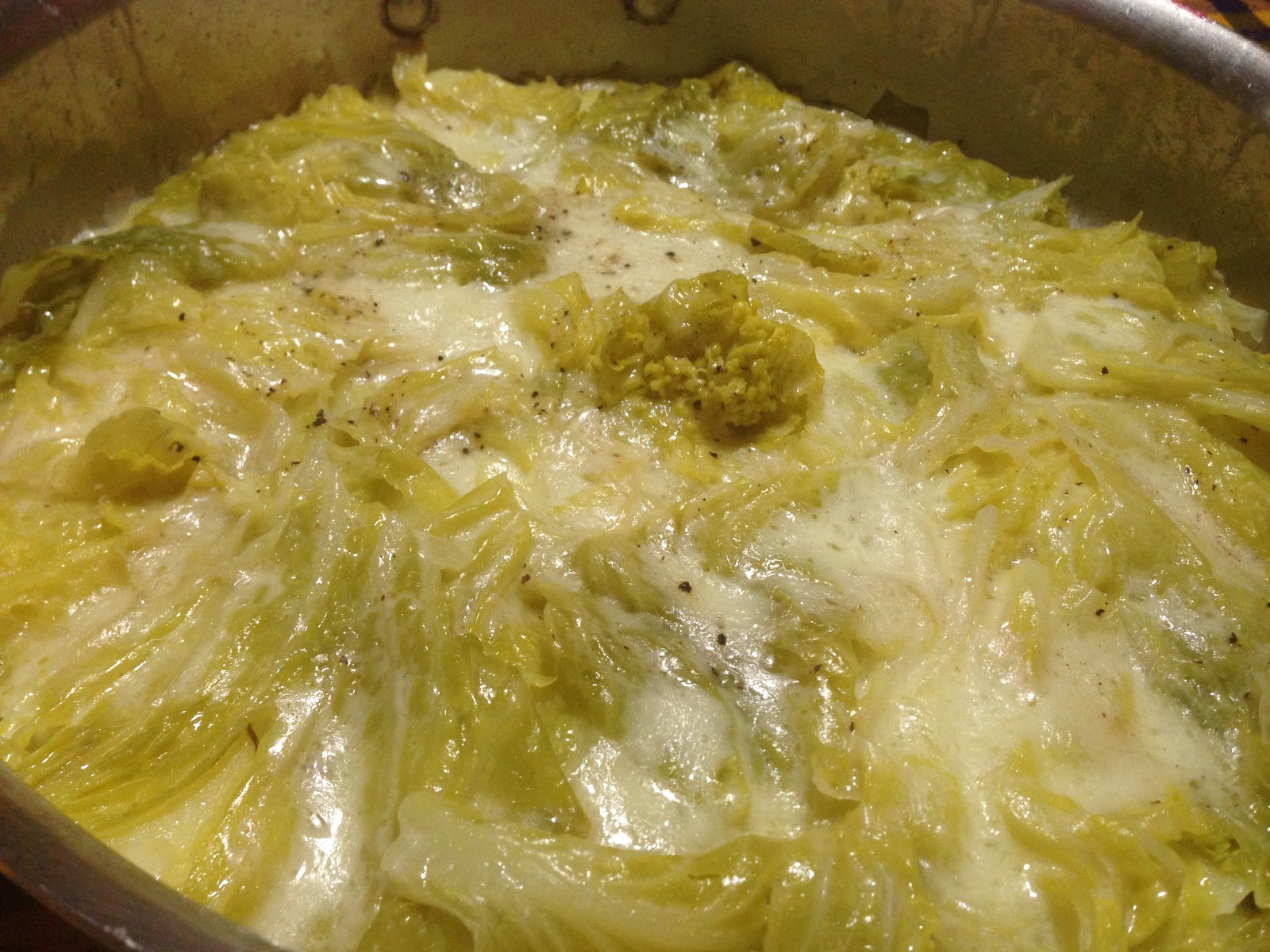
Savoy Cabbage Layered with Taleggio Cheese and Potatoes
It is finally spring and for those of us in the mountains it comes just a tad later than it does for most folks. I still have ample supplies of some of our winter staples like potatoes and savoy cabbage that we are using for a delicious result these days before all the spring delicacies take over. I thought I would share one of my favorite dishes combining these pantry staples. I am sure most of you are thinking of Easter with asparagus and peas and those sorts of veggies, but we are still having cooler temperatures here and sounds like we are not the only ones and this dish is one that I think is sure to please as it has just the right amount of comfort foodiness to it. Let me know if you agree.  
I made it the traditional way the first time in an oven proof pan in the oven and it was like a variation of scalloped potatoes, which will always make me think of my mom and growing up in southern Illinois. I added some parma ham once when I had some that need to be used up and I had some mozzarella as my only cheese, which worked out well with the ham giving it some needed salty element to the dish. I naturally have used all sorts of local cheeses because this is a recipe that lends itself to variations and innovation, so by all means feel free to add your own special touch.  My latest change has been to make it in a skillet on top of the stove without turning the oven on to great success. I do miss that crispy top crunch, but not enough not to make it when the oven is not part of the plan. This recipe is based on Antonio Carluccio's recipe that he used for one of his Italian sojourns that featured Piedmont. By chance it was one of the possible entertainment selections that was on offer on my flight back from the U.S. a few years back.  It was a great episode and a great reminder of a dish that is comforting to anyone and especially those of us from the former kingdom of  Savoie, where Savoy cabbage hails from. 

Savoy Cabbage from our garden and the stove top version 
Oh yes and if you are not familiar with Savoy cabbage, it is the one that is green and wrinkly. I find it to be mild and tender and certainly one of my favorites. It hails from this part of Europe and is a winter time favorite as it will keep under the snow for when you are ready to harvest it when needed. My in laws have always kept some all winter for not only our eating pleasure but also for salad for the chickens when she used to keep them. We aren't the only ones who like some greens in the winter. You can make this dish with regular smooth cabbage as well it just is a slighty different flavor and texture, but it will be almost as good, so do try and find the savoy cabbage if you can. but don't not make it if you can't.
I thought I would also share with you a little video I put together from our harvesting of the last of our cabbages a few weeks ago. We still have patches of snow dotted around now, but the "foehn" (warm strong) winds that have been howling for the past few days have helped the big patches evaporate rather quickly.   

This is me filming Fabrizio harvesting our Savoy cabbage a few weeks ago.  I hope you enjoy my second attempt at making a movie from my videos.


Savoy Cabbage and Potato Bake

(Cavolo Piemontese con Patate)

Serves 4

Ingredients:

650g / 1 1/2 lb Savoy cabbage, cut out the tough main rib* of the leaves leaving two halves of the leaves.
8 potatoes, peeled and thinly sliced (medium sized floury potatos, although red ones will work as well)
300g / 10oz Taleggio cheese, thinly sliced (or any other melty cheese, fontina, mozzarella and a little parmesan)
Some grated Parmigiano cheese to sprinkle on top and maybe between layers if you are using mozzarella
150g / 51⁄2oz butter for greasing your pans ( I didn't use it when I finished it in the skillet, although I did use a bit of olive oil.
salt 
black pepper, freshly ground
**I have added a layer of prosciutto crudo on occasion and used mozzarella and liked the results

Preparation:c
  • Preheat the oven to 200*C/400*F.
  • Boil some slightly salted water in a sauce pan. 
  • Cook the potatoes for about three minutes,in the salted water, then scoop the potatoes out with a large slotted spoon and set aside to cool. Plunge into cold water if you want to hurry them along and make them easier to handle when layering.
  • Cook the cabbage for about five minutes in the same potato water until tender. Drain well*.
*You can retain the cut out cabbage rib and the boiling water for a soup if desired or you might want to use it for adding a bit of moisture to your dish as it cooks if needed or dispose of both as you see fit.


You can finish this dish in two different ways. 
  • You will layer the cabbage, potatoes, cheese in a ovenproof pan or skillet depending on how you prefer to finish cooking this dish.
  • The original recipe calls for baking it in a 9"/ 23 cm(approximately) oven proof pan, which will give you a nice crispy top when you bake it.
  • You can also layer it all in a skillet and cook it gently covered adding milk or your leftover boiling water if needed, till all is bubbly and cooked through. 
  • Grease the ovenproof dish generously with some of the butter.
  • Arrange half of the potato slices, slightly overlapping, on the bottom of the dish, dot with some more butter
  • Season with salt and pepper.
  • Arrange the cabbage and half of the cheese on top of the potatoes 
  • Season with salt and pepper. 
  • Top with the remaining potatoes and cheese. 
  • Dot with the remaining butter.
  • A generous sprinkling of grated Parmesan cheese is a nice finish as well

Cover with foil and bake for 25 minutes, removing the foil five minutes before the end of the cooking time. Remove from the oven and serve.
Or cover your skillet with a lid and gently simmer on top of the stove until all is soft and smooth through. If you find the dish is too soupy, you can uncover it for a bit to evaporate some of the liquid. If too dry add some liquid as needed when cooking. 
I have made it both ways and enjoyed both. Sometimes you just don't have enough reason to want to turn on the oven and I am happy with the stove top results too. 

Hope you enjoy this dish.
Her's a stovetop version I served with some chicken strips I made

Hope you and yours will enjoy this hearty Piemontese dish. From our home to yours!

Bookmark and Share