 |
 |
| Free photo collage made with Smilebox |

Showing posts with label Italy travel. Show all posts
Showing posts with label Italy travel. Show all posts
25 December 2014
17 December 2014
Catching the "Slow Food Movement" Train

You would think I would have run out of things to talk about concerning "Slow Food" by now wouldn't you; but you would be wrong. I have only scratched the surface in these first couple of articles of the breadth and depth of this movement. This article is about what the Slow Food movement is really doing besides eating. My post today coincides with Terre Madre Day 2014. More on Terra Madre later on.
This third article is an overview of what I think of as the heart and soul of Slow Food and links to follow up and learn more. This is about the people that are "Slow Food", their concerns, the networking, the ideas and solutions to preserving and conserving and most of all protecting and sharing. It's about connection with our food, our earth and each other in a way that meets in many places and ways, but usually ending up at the table together to eat. It is also a call to join in the conversation whether or not you get involved with the formal organization or not, you can make choices that supports the small farmer and protects our environment. If you do join in, you will meet like minded people working towards a more equitable world and a better connection to our food and how it arrives at our table, hopefully doing as little harm as possible and hopefully maximizing the number of people around that table. First I will give you a brief run down of the organization of the movement, an overview of what it does, and them some of the highlights for me of my "Salone del Gusto / Terre Madre" experience this year.
The Slow Food's grassroots movement is organized into many networks of local and international groups. The main networks are described below. You can learn more about each of these groups at this link to the Slow Food website. Below are some direct quotes from their site.
Slow Food International is:
- Network of members with over 1,500 local "convivia" chapters located throughout the world
- Terra Madre Network is an international network of food communities - groups of small-scale producers and others united by the production of a particular food and closely linked to a geographic area."
- The Slow Food Youth Network (SFYN) is a worldwide network of young people creating a better future through food.
- The University of Gastronomic Sciences (UNISG) came to being in 2004, becoming the first university of its kind and offering a holistic approach to food studies.
The division of what Slow Food International's main focus of action can be described as the following:
- Defending Food Biodiversity: "coordinate projects that defend local food traditions, protect food communities, preserve food biodiversity and promote quality artisanal products..." These are some of their projects.
- "Presidia – Working with groups of small-scale producers to sustain quality food productions at risk of extinction in over 400 projects...
- The Ark of Taste – Cataloging endangered traditional foods: an extraordinary heritage of fruits, vegetables, animal breeds, cheeses, breads, sweets and cured meats...
- Earth Markets – Building an international network of farmers’ markets that promote good, clean and fair food…
- The Alliance of Chefs - Uniting over 300 chefs with local small-scale producers…
- 10,000 Gardens in Africa – Our plan to create 10,000 food gardens across the continent; in schools, villages and the outskirts of cities…
- Narrative labels - Going beyond legal labeling requirements to provide the whole story of a product..."
- Food and Taste Education
- International events to facilitate defending biodiversity, education and promoting networking.
- Raising Awareness of various current hot topics
 |
| Terra Madre Opening Ceremonies and Delegates in Turin October 2014 |
The opening ceremonies were held in Turin's Palasport Alpitour Stadium was a fitting venue, as it was used during the Turin 2006 Winter Olympic games and this slow food event had all the excitement and feel of being the Olympics of Food. Representatives from the 3,000 strong Terra Madre delegates paraded colorful national flags and often native costumes from 158 nations just like an Olympic ceremony. There was music and a wide variety of speeches from Slow Food Founders and organizers, stories of success from the Terra Madre and Youth Network as well as challenges facing Indigenous and other Terra Madre groups throughout the world. Every continent was presented with a voice to add to the conversation of food and how it is produced and used. This years theme being the Family Farm to coincide with the United Nations' 2014 International Year of the Family Farm. Other highlights were a video message from Michelle Obama thanking everyone for what they are doing to promote healthy eating and nutrition, as well as raising awareness of the issues across the globe." Pope Francis sent a letter stating that "no one should be without sufficient food." After all the speeches, Terra Madre representatives of the 3,000 strong delegates, from 158 countries,
paraded with colorful national flags and some native costumes. It was exciting, moving and impossible not to catch the enthusiasm and energy that night. It lasted through out the whole of the 5 days for me.
 |
| International Market - Youth Network- University of Gastronomic Sciences-Ark of Taste Pavillion |
 |
| Ark of Taste- Cataloguing Endangered Food Species |
The Ark of Taste project and display, which was fashioned to look like an ark, continued to grow over the 5 days as people brought food or photos of food that were special to their home or heritage that seem to be at risk of disappearing. One of our neighbors from Grandubbione brought some apples to add and register on the ark. I love that. It was fascinating to see so many different foods, some I certainly have never seen or heard of. It was touching to to hear peoples stories because food is one thing that unites us as humans, the need to eat and the desire to share food, love and fellowship. There was a lot of activity in this area as the BBC Radio 4 came this year and set up an impromptu studio and began to recored peoples stories about the food they were bringing to the ark. They will be broad casting these stories next year on one of their longest running programs, simply named the "Food Programm". I found it through their website and subscribed to their podcast via iTunes. I was able to down load their excellent introductory story here if you would like to listen to an excellent 3o minute program about their project and experience this year.
Follow this link to their program Terra Madre 16 Nov 14. You can also view many of these Ark food projects on Google's Cultural Institute . A very interesting site to discover. |
| Several Presidia Piemontese cheeses, salami and Lazio's Valpietra beans that I sampled at a taste workshop |
The Presidia is another International Slow Food project to save and protect species of native plants and animal breeds from extinction as they are usually no longer viable economically as the world globalizes and dictates what foods are available to us. The Presidia seeks to identify, protect and sustain ecosystems and traditional methods of production and economic pathways to keep our foods and livelihoods diversified and vibrant. I attended one Taste Workshop out of 107 offerings, that was entitled,
"Noble Indigenous Legumes, Extra Virgin Oils and Lazio Wines". It was a fascinating presentation. We sampled beans that were almost forgotten bout from several small villages in the Lazio region of Italy, some that had almost been abandoned but had seen a small return of families with a desire to grow their local beans and sell them in order to preserve them from extinction and to provide a modest income. We sampled black lentils and 2 types of white beans that were incredible in their simplicity and yet so intriguing in their flavor. The various olive oils from the Lazio region made different combinations to be delicious discoveries with such a simple flavor palette. Of course the wines paired nicely with all, but it was the creaminess of the beans and pure flavorfulness that continues to flick through my food memory. I like beans, but not normally large dry ones, but this giant one was so perfectly cooked, firm and intact with the creamiest of interiors.I read too that the rockiness of the soil where they are grown contributes to the thin outer skins. Aha, that is one of the things I usually am not crazy about is the tough outer skins. I had never really paid that much attention to a bean before. Hearing the farmers talk of how they only had 80 people in their village and hoped they would be able to produce and sell enough to continue on their life in their beautiful Valpietra, (valley of stone) made me determined that I found their booth to purchase some beans the next day to enjoy their deliciousness again in the future. I have a couple of small bags, that I am hoarding for just the right moment this winter when their creaminess will transport me back to their stories and imaginings of life in their village. |
| Earth Defenders - Lavazza's Calendar Project to Benefit "10,000 Gardens for Africa" |
is their 2015 Calendar "The Earth Defenders" project. Lavazza became more involved with Africa in 2002 with their Tierra sustainable coffee project to improve environmental, social and production conditions for small scale coffee farmers. They have been working with photographer Steve McCurry since that project to capture and document this part of their partner ship with coffee growers. The 2015 Calendar showcases everyday people in Africa that work daily to protect their food and way of life. You can learn more about each of these peoples lives and projects that they are working on in their communities to improve lives and protect their communities at this link. The proceeds of this years calendar will go to Slow Food's "10,000 Gardens for Africa" initiative. All of the people featured on the calendar are involved with various community projects that they have initiated or oversee. they are all involved with Slow Food through Terra Madre, The Youth Network, Ark of Taste, Presidium and many other branches of Slow Food. they all have compelling stories and interesting projects to put forwards. These photos tell much about their lives, home and livelihood.
 |
| Rob Bulga of the nomadic camel herding tribe Karrayyu of Ethiopia |
Earth Defender, Roba Bulga, an Ethiopian of the Karrayyu tribe of nomadic camel herders, spoke at the opening ceremonies about his involvement in setting up a cooperative of camel herders to sell their camel milk and the positive impact of this Presidium, coordinated by the Labate Fantalle NGO. Roba got involved with the first Terra Madre event in 2004 working first as a translator and was a founding member of the Labate Fantalle NGO. He has represented his tribe in several international conferences and been the subject of a documentary "Jeans and Marto" about his story and struggles of his tribe. He is a graduate of Addis Ababa in foreign languages and literature was well as a masters from Slow Foods University of Gastronomic Sciences here in Italy and has returned to his home to work for Slow Food and the way forward for his country and his people. He is a very inspiring young man, and so many others like him with their own unique stories and voices that add so much to the conversation. I enjoyed meeting him at the Ethiopian booth the first day after he spoke at the opening ceremonies. I know he will accomplish much more as he has done so much already in his young life. Go Roba and the Karrayyu people!
 |
| Marla Gulley with Roba Bulga |
One thing is clear our food system is in need of change. We can no longer stand by and trust our governments to fix it for us. This is a call to action for everyone to get involved locally in reclaiming our food heritage and protect the earth that supports us, in whatever way seems appropriate for your neighborhood. We must be bold even if it means shaming big business and governments into doing what is right for our health, our economy, our planet and most of all our children futures. Look around and find what you can do, even if it is being more thoughtful and discerning in your food choices. Going groups like Slow Food with put you in touch with other like minded people, because together we can make a difference.
 |
| Alice Waters, Jamie Oliver, moderator Corby Kummer and Carlo Petrini Conference on Slow Food in a Fast Food World |
I hope you enjoyed my articles and I thank you for reading them. Naturally these are purely my opinions and impressions of Slow Food Movement, Salone del Gusto and Terra Madre. I am not official connected to Slow Food, other than my affinity to their values.
Marla Gulley December 2014


04 October 2014
Rifugio Hopping in the Alps
 |
| Rifugio Selleries in Val Chisone Italy |
As the mountain huts of the high country begin to close their doors for the winter I wanted to share with you a few thoughts and photos that have been lurking in my unpublished blog posts since this summer.
It is my humble opinion, that one of the greatest pleasures of mountain life in the Alps of Europe, is the very civilized tradition of hiking up to the mountain huts or rifugios, as they are known here in Italy for a meal, or drink or an overnight stay. The summer season has slipped away before I could extol the joys of hiking and staying up in the part of the world where chamois and Ibex make their home, where the marmots whistle and warn each other that people are on their way, and the occasional grazing contented cow or two will dot the mountainside.
 |
| Cows on the way to Rifugio Selleries - Val Chisone |
I want to pique your interest into making sure that you put this experience at the top of your "must do someday" to sooner, rather than later, so you don't miss out on, what I consider to be, a most special experience. There is still time to hike in the high country before the weather sets in and there are a few huts that stay open all winter, but the majority of huts are put to bed for the winter. The people that run them, just like the cows and sheep that have spent their summer grazing up high, come down from their alpine eyries and do something different for the winter.
 |
| Val Pellice |
I have always had a passion for hiking since probably my teenage years of traipsing around in the woods with friends seeing the wonders of nature even in my backyard in the hollers of backwoods southern Illinois. We camped a bit as a family growing up, but we usually had a little camper and almost never used tents. Tent camping was a revelation. To be able to get to places whose beauty was so breathtaking and humbling, was intoxicating and definitely something I wanted to do as often as possible. Fast forward past the many backpacking trips in the Rockies when I made my home in the high country of Colorado to living in "the" Alps, the Italian alps. Now having lived in the Alps of Slovenia, Switzerland, Austria, and Italy for a number of years, I have been fortunate to be able to revel in the joys of skiing or walking up to a mountain hut just to have lunch.
 |
| Val Pellice |
Who knew that there would be people living at these huts and serving up food and drink for weary hikers so they wouldn't have to drag all that equipment and food around and just be able to breath in the beauty of the wildflowers, animals and skies of blue and sometimes weather that that makes you wonder what were you thinking? But then you get to the hut and there is hearty sustaining food for the asking, reviving or numbing drinks, warm water (usually, but not always warm) and either bunks or small private rooms to rest those weary bones. I have also been fortunate enough to sometimes stay overnight and on a few occasions been able to link a few days of hut to hut travel. What a fantastic time it is to be able to stay up in the mountains and walk to your next destination knowing you aren't going to have to find a proper tent spot, fire wood or crack out the camp stove and boil something. I must admit that I do sometimes miss that freedom, but hey, you gotta try this style of camping some time. It will spoil you rotten and you are supporting a livelihood of people who are there to provide you this most excellent service. Staying in a mountain hut is not fancy, definitely rustic, and always interesting. That at least has been my experience.
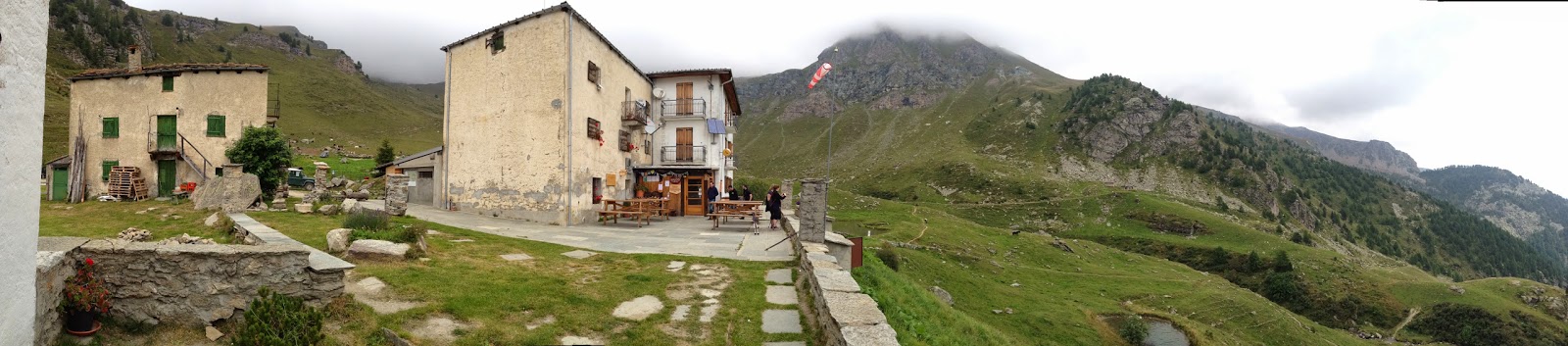 |
| Rifugio Selleries - Val Chisone |
When making your plans remember that most mountain huts are open from approximately June to mid June to the end of September, but that can vary depending on how high up they are and how fast or slowly the snow melts in the spring. We have a variety of huts in our valley and there is a wonderful circular itinerary close to us called the Monviso Tour / Val Pellice that circles Monviso mountain, which is the highest peak in our range of Cozie or Cottian alps. The circular takes a minimum of 5 nights in alpine huts and walks between them are gauged in manageable distances. It is good to factor in a couple of extra days just in case the weather is uncooperative or the snow hasn't gone or arrived unexpectedly. That doesn't always happen but weather does happen, so it is good to have some extra time too just in case you need to use it.
There are various huts listed on the itinerary with numbers to contact once they are back in business for the season. Most huts have quite a lot of room for travelers, so there usually isn't a problem to get a place to sleep, but usually helpful to make a reservation during the busiest period during August when most of Europe is on holiday. My understanding too is that huts can not turn you away even if all of their dedicated beds are full. They must offer floor space and shelter as is the tradition of the high country. I did see that happen once in Austria when we came down in the mooring there were people scattered all over the floor. Probably not the most comfortable night, but better than being outdoors without the proper gear.
Most stays are modestly priced at € 25 for sleeping with breakfast, add another €20 for dinner and if you would like a sack lunch for the trail that is around €10. They provide a blanket and sometimes a pillow, but you need to carry a sheet sack so that you are cocooned in our own person sheet. these are relatively in expensive at most camping stores and are availably here in Pinerolo also. So a nights stay in a dormitory room with three meals comes in around €55 ($70 / £43, prices will fluctuate depending on the exchange rate for non European visitors). These are 2014 prices.
Drinks are usually a separate charge. Some have private rooms for a slightly higher price, usually another €10 person, give or take. The prices reflect the effort it takes to get much of the food supplies up to the huts. Some huts are supplied by trucks, mules or helicopters, so there is some expense involved for the hut masters.
A phrase book is always handy if you are short on languages spoken other than English.
I have always found the food to be good and the drinks, especially the alcoholic ones very welcome.
That is some basic information that you can put into planning when you make your way to the Alps for some breathtaking vistas, chance meetings with others on the trail, flora and fauna, and awe inspiring days out.
 |
| Polenta and venison stew |
 |
| latte macchiato |
Can't commit to more than the day? Well, there are still a number of huts that make for a great day out with a hearty and delightful lunch up, sometimes, in the clouds and certainly closer to the heavens.
Start planning your hut trip now so you have something exciting to anticipate for the next nine months.
If you have any doubt that it's worth the effort, come and stay with us before your hut to hut adventure and we can help you plan it or visit us afterwards and enjoy a bit of pampering and reentry into putting up your feet and relaxing. We can even teach you to make some local specialties if you want to join in one of our Cooking Together classes whist you are here. Our Bella Baita is a great choice for starting or ending a trip or just making this base camp for your alpine adventures. We'll be in the garden or kitchen whipping something up for your arrival. Ci vediamo presto! (See you soon!)
 |
| You can never have too much fun in the Alps! |
Subscribe to:
Posts (Atom)
