Showing posts with label Italian. Show all posts

26 February 2017

Pasta and Potatoes / Pasta e Patate - A Classic Recipe to Chase the Chill Away

Pasta and Potato
Pasta and Potatoes
It's still chilly these days even though February this year was milder than usual and bowls of hearty vegetables and pasta still go a long way to taking the edge of that chill off. This particular recipe I started making this summer after one of our volunteers, Mascia, prepared us one of her favorite dishes, her grandmother's recipe for pasta e patata, or pasta and potatoes. It's always a treat when someone cooks for us, and especially so when its from one of our volunteers. We've had a variety of International cuisines over the years, Japanese, French, Dutch, Italian vegan / macrobiotic and even my familiar American. 


Most everyone can always use another pasta dish to add to their repertoire.This one seems to be a classic dish in many parts of Italy with as many variations as their are cooks I would imagine. In it's simplest form it is very much like what many of us think of as minestrone soup without the beans. Some people like to add a bit of saltiness and flavor punch by adding in some form of porky cut of meat with various levels of fattiness and smokiness or not. Some like a bit of red pepper zippiness or a touch of oregano. Most are a thick "stick to your ribs" kind of consistency. The Neapolitan version is  finished off in an oven proof dish smothered in smoked, or not, provolone cheese slices and heated till the cheese melts and served right away. 
This version is a simpler straight forward version that Mascia insisted that the butter used to sauté the vegetables was her nonna's secret ingredient.  Here in the north they are fond of using butter and it does make a tasty addition to this simple dish and is highly recommended. What ever your preference might be I think you will find this classic pasta dish a great comfort and "go to" recipe for any day of the week. 
Thanks Mascia for sharing your nonna's recipe. 


Yield : 4 servings

Ingredients:

2-3 T olive oil, extra virgin
30g / 2 T butter
50 g smoked pancetta, prosciutto, or guanciale (optional)*
80 g / 1/2 c  white onion 
80 g / 1/2 c carrots, diced
80 g / 1/2 c  celery, diced
100 g / 2/3 c cherry tomatoes or pachino, blanched, peeled and diced
or some ready made tomato sauce or a combination of the two

3 ½ – 4 cups water or stock
1 vegetable bullion cube, use if you don't have chicken or vegetable stock
500 g / 2 3/4 c potatoes (peeled and cubed)
160 g / 1 1/3 c small shaped pasta ( small tubes, wheels, gnocchetti, mixed pasta, half penne)
2 -3 Parmigiana or Grana Padana crusts (optional)*
Parsley chopped to garnish  or some oregano as some recipes call for 

Grated Parmigiana to sprinkle
Salt and pepper  or hot red pepper to taste

*Variation: In Naples and other southern parts of Italy they will put the finished dish in oven proof bowls and cover the top with some slices of smoked provolone cheese. Heating it to melt the cheese before serving.

Directions:

In a medium pot, at least 2 qt/L, heat your pan, then add the butter and olive oil.
Once the butter has melted and the oil is heated, add the diced onion, carrot and celery.
Sauté the vegetables on a medium heat for a few minutes.
Cook until the vegetables are soft, but hasn't picked up any color, about 3-5 minutes.
Then add the meat if using, and tomatoes, cook a few more minutes.
Add 3 cups of water to the sautéed vegetables along with bullion cube, if using
and the potatoes and pasta.
Taste and adjust seasonings keeping in mind that the crusts will add salt to the dish.
Add the Parmigiana crusts if you have them.
Cook until the potatoes and pasta are cooked, adding the other ½ -1 cup of additional water to reach a creamy texture, but not too soupy.
Serve hot and garnish with Parmigiana if desired. 

Buon appetito!!

02 May 2015

Weed Your Garden and Make Ravioli Gnudi with Nettles Recipe

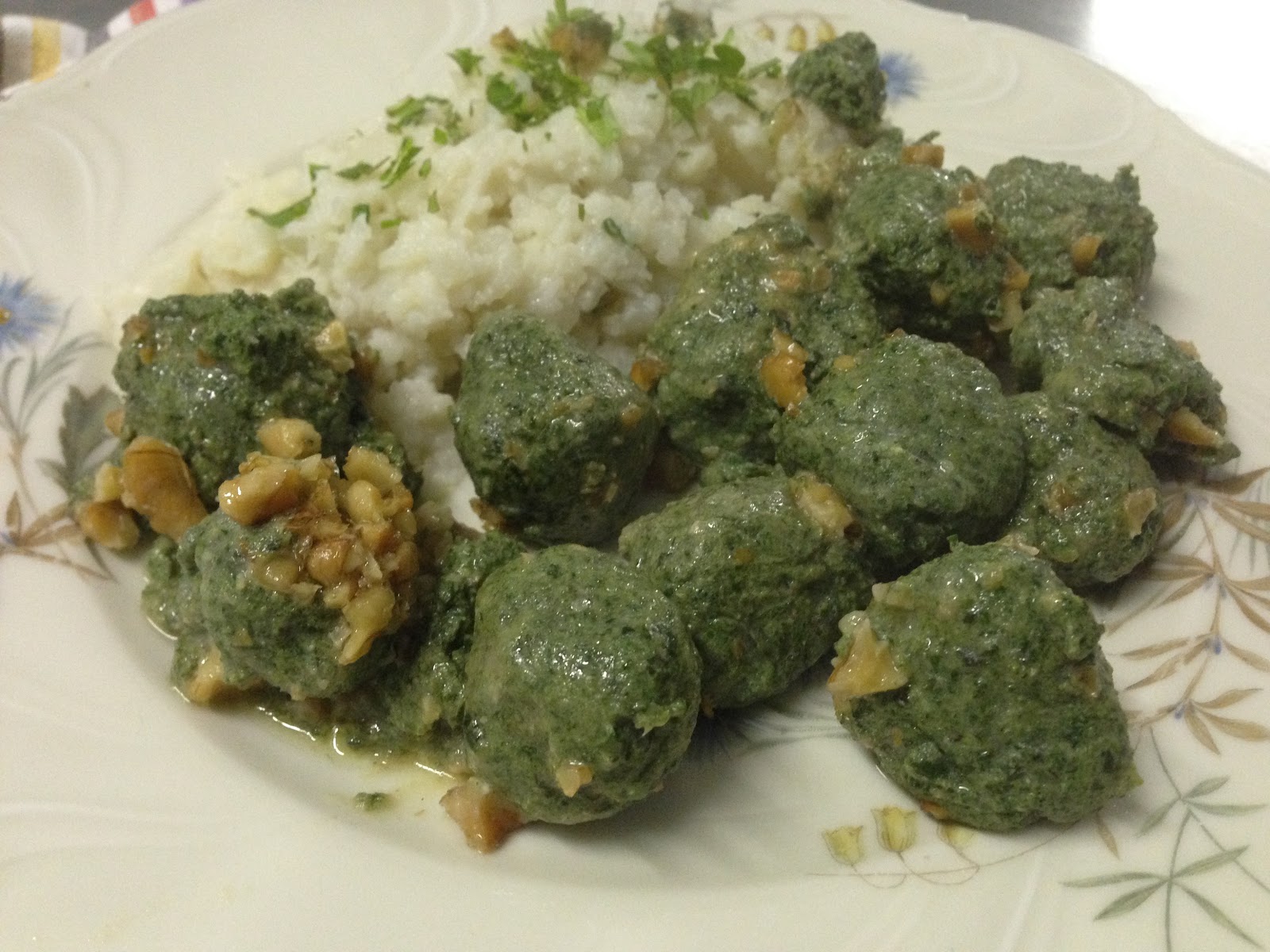
Nettle Ravioli Gnudi with a Side of Smashed Cooked Cauliflower
Spring is here at last in full form and we all breath a sigh of collective relief. Ones attention turns toward activities that will take us outdoors after our winters nap and we fell the sun on our face and the fresh air fills our lungs. We can finally get our hands into the dirt and begin to plant that garden we've been thinking about all winter. We begin to eat a lighter fare after all of those hearty dishes of comfort that we rely upon to get us through times of cold and longing for the delicacies of summer. Naturally we dip back into those comfort foods at will, especially in the changeling seasons of spring and autumn before the season steadies on with, full on, hot or cold. However let us forage forward with a dish that is somewhere in between. 
A popular dish from the Tuscan region of Italy is called ravioli gnudi or naked ravioli. 
Adam and Eve "gnudi" - Mural Painting in the village of Usseaux
That's right folks, this is the ever popular spinach and ricotta filling rolled into balls and left without its pasta cloak on, then rolled in a bit of flour coating and lightly boiled. Once they have sunk to the bottom of the pan and then floated to the top, they are gently simmered for a short time. They are lifted out and drained of water and tossed into to your favorite sauce, and voila`, springtime is served up.
Stinging Nettles in the wild
Naturally, I took a turn and headed for the garden and after pulling a copious amount of stinging nettles from between my currant and raspberry canes, I became inspired to swap out the nettles for the spinach and use rice instead of wheat flour to make them suitable for celiacs or gluten intolerant folks. The way these are boiled by gently dropping them into the water, where they promptly sink, and then waiting for them to come bobbing back up to the surface and simmer just ever so slightly, is reminiscent to me of our beloved northern gnocchi. It's the same cooking method and determination for doneness. For this subtly flavored wild green, that loses its ferocious sting once it is cooked, I used a simple butter, walnut and chicken stock combination to showcase and elevate the nettle flavor as well as add the Piemontese favored walnut for added texture. It all worked very well I think.  
Italians are very fond of stinging nettles or "ortiche" as they are called in Italian and are liberally used in soups, tea, pasta, crepes and any  filling that would use spinach. They are purported to have a fair amount of health benefits, such as helping to reduce hypertension, and asthma,  relieve arthritis and menopause, encourage milk production in lactating women, break down kidney stones, and help with diabetes, just to name a few. Maybe it does or doesn't do these things, but they are tasty and a change from your regular spinach consumption. 
Please note.
While I do recommend that you give these a try when you find some nettles that haven't gotten too old or gone to seed, if possible. The younger plants flavor is mild like spinach, but do be forewarned, they sting like the dickens, so wear protective gloves and maybe even long sleeves when picking them and kitchen gloves when cleaning them. *When cleaning them, give them a thorough water rinse, using a good slug of vinegar if you want to make sure and get them thoroughly clean, and don't forget to wear your kitchen glove.  Drain and sauté them in a tablespoon or two of olive oil or butter till they wilt , adding a bit of water so that they cooked through. Squeeze them dry before chopping and adding them to the ricotta. If you aren't able to find any nettles or aren't so adventuresome, then by all means, replace the nettles with an equal amount of spinach.


There are a number of recipes you can find online, but I modified and put my own spin on Barbara Elisi's recipe that you will find here.  

Stinging Nettle and Ricotta Ravioli Gnudi

Ingredients:

250 g (9 oz) ricotta (drained by setting on a sieve or strainer)

250 g (9 oz) fresh nettles (*cleaned, see note above, cooked, drained, squeezed dry and chopped)

1 egg, medium

100 g / 1/2 generous cup, Parmesan cheese, grated

1 or 2 T of rice flour ( if the dough looks too soft add a tablespoon or two)

1-2 T  olive oil or butter to sauté the greens

Rice flour ( for rolling the formed balls in before simmering in water)

Directions:

Wear gloves to pick and clean the nettles
Weed your garden or find a patch of nettles and pick a goodly amount of nettles to bring home and clean. 

  • Set the ricotta in a strainer to drain the water off. 
  • Strip the leaves from the stalks, discarding the stalks and place in a bowl and cover with fresh water and swish around letting set to let debris fall to the bottom of the bowl. 
  • Discard and repeat the process till the greens are clean, as mentioned above. Drain the greens of water.
  • Sauté in a small amount of oil or butter till wilted and cooked.
  • Squeeze dry (gloves not really necessary now)
  • Chop the greens small.
Once all the ingredients are ready,

  • Whisk the egg lightly in a medium bowl and add the ricotta and nettles and mix lightly just to combine.
  • Add rice flour if you find the batter too soft to manage.
  • Fill a roomy pasta sized cooking pot full of salted water to a boil.
  • Using a teaspoon or your hands and drop small amounts of your mixture onto a rice floured surface or drop rounded  nettle ricotta balls into a small bowl with rice flour and roll around to shape into balls and coat with the flour. 
  • Set the coated balls aside until your water is boiling and your sauce is ready to go.
  • Roll the batter spoonfuls into the flour and then 
  • Drop into the boiling water. 
  • When the gnudi emerge on the surface of the water, boil a further 1 minute or so and
  • Gently drain with a skimmer. 
Combine with Walnut Butter Sauce sauce and serve.

Butter Walnut sauce: 

100g butter (sometimes I use less butter and add a bit of chicken or veggie stock to lighten it up )
200 g walnut, rough chopped medium
Melt your butter and add you r chopped walnuts and cook lightly till bubbly.
Add your hot cooked ravioli gnudi.

Mix to coat and serve hot with a generous grating of Parmesan on top.

Ricottan and Nettles mixed

All rolled in rice flour and waiting to be boiked
Ready to go into the sauce
Voila' Nettle Ravioli gnudi is served

24 January 2015

Baked Pumpkin and Brussels Sprouts Rigatoni


This time of the year I find I am drawn to write more about recipes as I spend more time at home trying out new recipes that there never seems to be enough time for in the summer. I also find that many recipes are predicated by what's on hand or what is begging to  be used up. The garden provides a fair amount of winter veggies in such abundance that new recipes are definitely in order. Back in the autumn when I saw this recipe on one of my favorite TV cooking programs,  for what seems to me to be an adult version of macaroni and cheese, I knew I was in. I just happened to have an excess of pumpkin and this years crop of Brussels sprouts was abundant, which just happened to be two of the main ingredients of this pasta al forno, which is what oven baked pasta is called here. 
I do like creamy cheesy baked pasta, but  the thought of replacing some of the cheese with pumpkin or winter squash for a creamy and rich sauce that's not too much. This version is a tad lighter yet satisfyingly scrummy. I find this is a great way to use up odds and ends of cheeses and different varieties of pumpkin or squash. Its just good if you have a soft disintegrating variety of pumpkin and one that holds its shape, for added interest in this mix. Caciocavallo cheese is very much like provolone and yet I found other cheeses work quite well also. So if you don't have  the exact ingredients, don't hesitate to sub something that you prefer or have on hand. That's most of us do anyway, so feel free to use this as a framework for making a comforting pan of cheesy pasta and vegetables. I am sure you will agree. 
Mix and adjust the pasta to your taste

The pumpkin seeds add a great dimension of texture and flavor

Baked Rigatoni with Winter Squash and Brussels Sprouts 

Serves 6
Ingredients:
10 oz / 300 g pumpkin Kabocha or other meaty winter squash, cut into cubes 1 leek, cut into slices
2 bay leaves
3 T olive oil, extra virgin
1 3⁄4 c / 400 ml milk
10 oz / 300 g pumpkin Delicata, cut into pieces
4 T pumpkin seeds, divided in half
3.5 oz /100 g parmesan, grated
10 oz / 300 g cacio bucato or caciocavallo or provolone or whatever cheese you would like
7-8 oz / 200g ish Brussels sprouts, trimmed, washed and cut in half. 1# / 500 g of rigatoni
Pumpkin oil
salt

Method:

Place two tablespoons of olive oil and leek, in a saucepan.
Saute` slightly and then add the Delicata pumpkin pieces and season with some salt. Cover and cook over low heat, until the pumpkin is soft.
In another saucepan, place the pumpkin pieces with milk, half of pumpkin seeds, salt and bay leaf, Simmer for about 12 minutes on medium heat until the pumpkin is soft.
Remove from heat and keep warm.
Mix with an immersion blender, ( I would do this after the pasta is done)
Stir in half the cheese and half the grated parmesan.
Cook the pasta in salted water, I cooked about halfway before adding the brussel sprouts.
The original recipe add them together at the same time. I just preferred the sprouts to not be overcooked.
to which will be added also sprouts
Drain the pasta al dente, Toss the pasta and sprouts in a bowl with the the pumpkin cream.
Add the pumpkin stew and a generous sprinkling of Parmesan cheese.
Mix well.
Place it in a 9x13 baking pan (I lined the pan with parchment paper )brushed with pumpkin oil. Top the pasta with the grated cheese and sprinkle the other pumpkin seeds

Bake at 375* -400*F (200 °C ) till bubbly and top has browned.
Adult Mac and CheeseDon't you just love the crispy bits on top? I do.

10 January 2015

Something Old, New and a Homemade Orecchiette Recipe

We are well on our way into a new year, 2015,  and yet at this time of the year I often find myself looking backwards as well as forward.  When Jennifer of  the blog "Vino Travels ~ An Italian Wine Blog & Luxury Tours to Italy", recently contacted me about collaborating on a wine pairing event that would be featuring one of  Puglia's famous wines, Negroamaro, Gaglioppo or Primitivo, a dinner made for us by friends from Bari, a few years back, sprang to mind, "Braciole"* and Orecchiette pasta. (* Braciole translates to chop and usually refers to pork chops, especially in the north of Italy, but in Puglia it refers to a meat roll cooked in a tomato sauce. The meat can be pork, beef, or even horse)This dish was made for us by some friends that we met during the lead up to the 2006 Winter Olympic Games that were held in our area. We became friendly with some of the workers that came up from south Italy with their company to build the two tunnels that helped ease some of the congestion of the traffic on our road that leads up to Sestriere and where several of the venues for the games were held. This group of tunnel makers were made up of two groups, one from Bari in Puglia, and the other from Sicily. We had helped them out with a variety of things that come up when you work far away from your home and friendly faces are always appreciated. They had an impromptu home leave break when the winter weather made working on the tunnels impossible for a few days, so off they went back home. The tunnel project took  over two years to complete prior to the commencement to the games, so they were away from home for quite a while. 
Baldassini tunnel workers on the day they broke through on the second tunnel

Once they returned from their break, they asked if they could make us a traditional Pugliese dinner. Sounded good to me. I love eating other peoples cooking especially when they are so keen to share their regional cooking with us. When they treated us to dinner, we discovered that they each had all brought back different treats from home. One brought his family's olive oil pressed from trees that were over three hundred years old, home made Pugliese wine, Sicilian desserts and hand made orecchiette by one of their wives. What a special dinner that was. It was fun to watch them prepare everything and then all sit together for a special meal. A dear friend of mine from college days along with her daughter just happened to be visiting when this dinner came together, so we had a cozy full house in our intimate dining room. That meal still lingers in my memory and the revelation of how wonderful hand made pasta is I can also manage to savor. So naturally I just had to try and recreate this dish. 

Fabrizio and chef for a night Guiseppe and the whole Baldassini gang and my southern Illinois friends for the special dinner
This traditional dish is a typical Sunday family dinner where the meat is cooked in a rich tomato sauce. Orecchiette has been made earlier and left to dry before marrying it up with the sauce that the meat was cooked in.  This recipe is what I like to call a two for one recipe; two dishes made from one source.  If you make the pasta as opposed to buying dried pasta, then it will be a little more labor intensive, worthy of a big Sunday family dinner, however, If you buy dried orecchiette, this comes together quite easily for any day of the week. Do try it and pair it up with a Primitivo if you can find it, or if all else fails, try a California Zinafindel (not a rose' but a rich fruity red) that will transform this into an unforgettable memory whenever you wish. 
A pictorial tour of my version using home canned passata and conserva (tomato sauce and paste)
My hand made orecchiette, or little ears

Meat rolls and Orecchiette Pasta with Sauce 
Braciole e l'Orecchiette con Sugo
Serves: 6

Ingredients:
6 thin beef or pork steaks,* 
6 squares of firm pecora cheese, or other firm cheese, optional. I used caciocavallo. 
6 garlic cloves, minced and divided for sauce and inside the meat rolls, (adjust amount to your taste, as this is Giuseppe's strong garlicky version. He actually used a lot more)
1 large carrot, diced
1 large celery stalk, diced
1 large bottle or jar of tomato sauce
1 T tomato paste 
2 tsp mix of thyme, oregano or any blend you like. 
1 bay leaf
slash of dry white wine, optional i used water as i didn't have any wine available
dash dried hot red pepper  
Olive oil

Pecorino or Parmesan cheese, grated to garnish the finished dish

600-800g / 1.5- 1.75 lb dried orecchiette pasta
or 
Homemade orecchiette recipe and video below*

Cooked  green vegetable to go with your meat rolls or salad 

Preparation:
Lay steaks flat and place a generous amount of minced garlic toward one end of the steak. You can make this with just a thick chunk of cheese or a combination of both. 
Pull and fold over both sides of the length of the steak towards the center.
Bring the one end over so the contents are enclosed and roll up. Secure with a toothpick.
In a sauce pan or large skillet with tall sides place your oil and begin to heat. 
Add the carrot and celery and begin to saute' until fragrant. 
Add the remainder of your garlic.
Add dried herbs and bay leaf.
Stir to distribute and place your meat rolls in the pan.
Saute' lightly on all sides to pick up color. 
Deglaze your pan with a little white wine if desired. 
Let the alcohol evaporate and add the tomato sauce and paste.
Cover and cook for about 15 minutes. 
Remove meat rolls and let the sauce simmer a while longer adding a bit of water if it cooks down too much. You want an nice thick sauce that has let all the flavors meld together. Perhaps 30-40 minutes tops. 

*Cooks Notes* Thin cut beef steaks are from the rump of the cow, most likely a round steak, here they have a large roast piece of meat and slice thin slices about 1/4 or slightly thicker slices. Ask your butcher for suggestions. If using pork, a pork cutlet with  little bit of fat is nice as well. 

*If making home made orecchiette pasta, make it first so that the pasta has time to dry before cooking. You can make the pasta a day or several before also. Just make sure to keep the pasta dry and they will need to cook slightly longer than the fresh pasta. 

Amount per person is about 2 1/2 oz / 80g per person so you can adjust according
(Note* home made pasta usually goes down quite easy)


Orecchiette Pasta :
 6 ish portions

500 g / 18 oz semolina flour  or semolina
200-250g / 6.5-8 oz  water, warm to hot 

Make a mound of flour and hollow out the middle to make a well. 
Add some water and begin mix with your your fingers like a mixer.
Add more water and mix until you get a solid, yet soft dough. 
Work the dough as you would bread to get a smooth dough that has developed the gluten. 
Once you have the dough developed and smooth, Set aside and either cover with a bowl that you weighed your flour in or a piece of plastic to allow the dough to relax, but not to dry out.
Set aside for about 15 minutes. 

Cut your dough as you need it , ultimately in about 8 -10 pieces. 
If you have a wooden surface to work on, that is the best surface for making pasta dough. 
Take one piece of dough, leaving the others covered while you roll out a long thin snake of dough.
Roll out the dough with your hands on top of the dough laid flat on the work surface. Gently roll the dough into a long piece about 1/4-1/2" thickness, depending on how large you want your "ears" to be.
Once rolled out, Take a butter knife or small pallet knife and cut the dough off into about a nickel sized portion. 
With your flat edge of the knife drag the knife from one side of the dough across to the other applying steady pressure so that the dough crawls up and curves over. Pick the piece up and unroll it if need be and fold it opposite of the way it tried to roll up, so that it forms a cup. 
Lay them side by side on a plate or wooden surface that has been sprinkled with semolina to dry till they are not sticky to the touch. Feel free to sprinkle a bit of semolina over the tops as well if you need them to dry up a bit more.  Avoid making these on very humid days as it is with most home made pasta.  continue on with all of the pieces of dough till you are all done. 
Go back and make you meat rolls and sauce while your pasta dries. 

If you watch some of the ladies of Bari making them they have a two stroke method that I have yet to master, but certainly will be striving for.  Like many things it just takes a lot of practice. 
I am going to add a  little video that I made to practice not only my orecchiette skills but also my video skills as well. Hope you like it. 

Finishing and serving:
Bring a pot of salted water to a boil.
Add the fresh pasta and boil gently till cooked to your preference. Normally it only takes a few minutes like 4-6 unless they are very dry or very thick. 
If using dry store pasta follow the directions on the package for the timing. 

While the water is coming to a boil, put the meat rolls back into your sauce and heat the sauce and meat rolls back up so that everything is piping hot.
Remove meat and set aside, keeping them warm somewhere till you are ready to serve them after the pasta course.
Drain your pasta, add to the sauce and toss to coat the pasta. 
Serve immediately, garnishing with the grated cheese to taste.  

Serve your meat rolls with a vegetable side dish or salad of choice.

30 August 2011

Meet Guido Ronchail, Sculptor and Ghironda Maker of Pragelato


The Maestro and one of his Ghironda


One of the wonderful things about being married to a local mountain guy, and there are too many wonderful things to mention, but one of his many charms is that he speaks the local Piemontese dialect, which is a calling card for acceptance rather than suspicion. It is a very useful gift when we are seeking out the not so well known and sometimes inaccessible gems that there are to discover in Val Chisone and Germansca or the greater Piedmont region. Fabrizio, my husband, not only knows most of the valley, he has a way of getting most people to open the door and their life to us with just a bit of chat and genuine interest. It is a wonderful quality that I admire and benefit from in so many ways. Recently we went up to Pragelato in search of S.gr Guido Ronchail, a man of many talents who also is a bee keeper, sculptor, and maker of the Ghironda, also known as a hurdy gurdy, which is a medieval folk instrument, popular in traditional Occitan music.


Wooden Sculptures in his garden in  Pragelto
Our valleys are part of, if only just, the outer most border of the historical Occitania region. We were once part of France, and even longer were we part of the Savoy kingdom, but now firmly Italy. Mr. Ronchail has lovingly restored and enhanced his traditional old home with his wood working and masonry skills along with many artistic flourishes, as well as adding a gallery for his collection of mainly stringed instruments with the Ghironda, prominently featured. 
Stone gate leading to his garden and musical instrument gallery
 We dropped in one day following up on an invitation from him when we ran into him at one of Pragelato's Tinber art gallery's opening, which had featured some of his work, along with fellow sculptor Carlo Piffer of Sestriere. 
What a delightful day we enjoyed as we chatted about his work and admired his workshop that had accomplished many projects and had so many more in various states of progress. It was a clutter workshop that he apologized profusely for it's state of disarray, but I found comfortable and fascinating as I surveyed the tidy stacks of home made tin can drawers and pieces of musical instruments strewn about. His canine companions bed tucked up in the corner and his trilling orange feathered canary were part of the charm of this well used and loved work area where he spends endless hours tinkering about on his various projects.
Various parts of instuments
Beautiful canary songs to work by
Tools of the trade

Several clock projects

Drawers made from old anchovy cans

After a bit when the stories were flowing, he pulled out a bottle of slightly sparkling local red wine and we quenched our thirsts before moving on to take in his wonderful collection of Ghironda and various other stringed musical instruments, hung whimsically from the ceiling or scattered about the spacious room. It is a delightful collection of various ages and types from different parts of Europe.
Three Ghironde


Ghironde with Appalacian dulcimers on wall and various clarinets 
He also had a mountain dulcimer whose home harkens from Appalachia in eastern America, an instrument with whom I am very familiar. It is not a proper museum per se, but he is happy to share it if we want to bring small groups to visit on one of our small tours. I am sure we will, especially as his son and daughter in law have built a small artisanal dairy shop where they make a wonderful aged Toma cheese, not unlike nearby Cuneo's Castelmagno cheese, from their 5 cows. It's a delightful cheese made by a delightful family. 

Guido's sculptures and artisan cheese shop

Where they store their cheese

The proof is in the tasting
And if all of this hasn't convinced you to get off the beaten path with us then there is always the Ghironda festival in August for some Occitan dancing. We arrange small tours that covers a wide range of interests, mainly about food and drink, although the culinary aspect is an important part of  experiencing a place, immersing yourself in the cultural parts of is interesting and of course, fun. 

We are happy to organize a variety of experinces for you depending on your interests and the time of year, through our T.E.M. association for promotion of our valley. If we have a group of 6-8 we can tailor a holiday or short break for you with our full attention, for groups less than 6 we have to consider the demands of running our B&B and balance it all out. Write us for more information, Info@bellabaita.com and have a look at out web site, Bella Baita Italian Alps Retreat. We'll be waiting for you.


27 April 2011

Pasqua, Pasquetta, and Primavera musings

Our wild cherry trees in bloom
Springtime in Italy's northern mountains is well and truly underway. As always the weather is a source of conversation and speculation. We had summer like temperatures in the early part of April tricking our wild mountain cherry trees into thinking that they were late for an important date and beginning to bloom before most of the trees had even thought about leafing out and almost a month earlier than usual.  A few day trips around in the valley and plains where fruit production is one of the main farming endeavors we saw blossoms galore, cherry, pear and apple all just a wee bit early for comfort. Mountain weather can be most unpredictable at best and down right heart breaking at times. So far so good. We have weathered a couple of cold snaps and our fruit trees haven't been nipped in the bud, so we'll revel in all this primavera glory. 
Staffarda Abbey with Monviso in the background
Easter has come and gone now and what a week it was. It seemed everyone had spring fever and an itch to get out of the house and go somewhere, anywhere, even if, just for the day.  Our SerreMarchetto neighborhood was bustling with activity with all of the extended family up for Easter lunch. 

Easter lunch with friends and family
Peasant Bread, Easter Egg bread and Chocolate Torte
My contributions to lunch
We did our part to make a group passeggiata after pushing away from the remnants of the epic holiday lunch to do the ciao ciao with our neighbors and survey what was new in our surrounding woods. We caught up with who had been chopping wood on their property, what was in bloom, what already had berries, the wild blueberries, very surprisingly, who was fixing us their property or putting out some replacement flowering shrubs and on and on till we stumbled back home to face a couple of drops of grappa and coffee before we put together some of the leftovers and a smal bollitto misto, before the dispersal home. 
Friends from New York looking towards home
Passeggiata photo at our SerreMarchetto overlook
Then comes Pasquetta, or little Easter, the Monday after Easter is national picnic day. It seems sometimes to almost be more important to Italians than Easter. Everyone heads to the hills or seaside or flees from the family to picnic with their friends. 
Fair Fare
This year was triply interesting because Pasquetta also happend to fall on April 25th, which is Liberation Day, when the allied forces freed Italy in WWII and it happened to be the last Monday in April which happens to be the ongoing Pinerolo semi annual fiera or fair. 
Italian Liberation Day WWII
If you couldn't find something to do Monday, it wasn't for a lack of offerings. We managed a couple of the offerings. We drove to Pinerolo to take in the fair and see if there was anything we couldn't live with out, and were rewarded with a couple of hand painted platters, one decorated with olive branches and the other with local favorite icon, porcini mushrooms. On our way there we stopped for the town marching bands and military displays. I could have stayed longer at all of the different festivities, but we had a bbq to attend and the ribs were calling our name. The show rolled on. 
Master bar b que chef cousin Paolo
Italian ribs and sausage
We hadn't been to our cousins place before and it is a nice oasis in the fertile flats of the Po river valley. The grass was tall, the weather warm with a gentle breeze and apricot trees that had fruit big enough to start thinking about ripening. 
Green apricots April 25, 2011
Incredible. 
They are at least a month or so early. I was truly astonished. 
Pasquetta Picnic
Another round of eating, and some family tales and fellowship before heading home with the holidays being truly over. Well, at least until May 1 when there is yet another  holiday, the Italian equivalent of Labor Day. 
Whew, these holidays are hard work.  
Bookmark and Share